
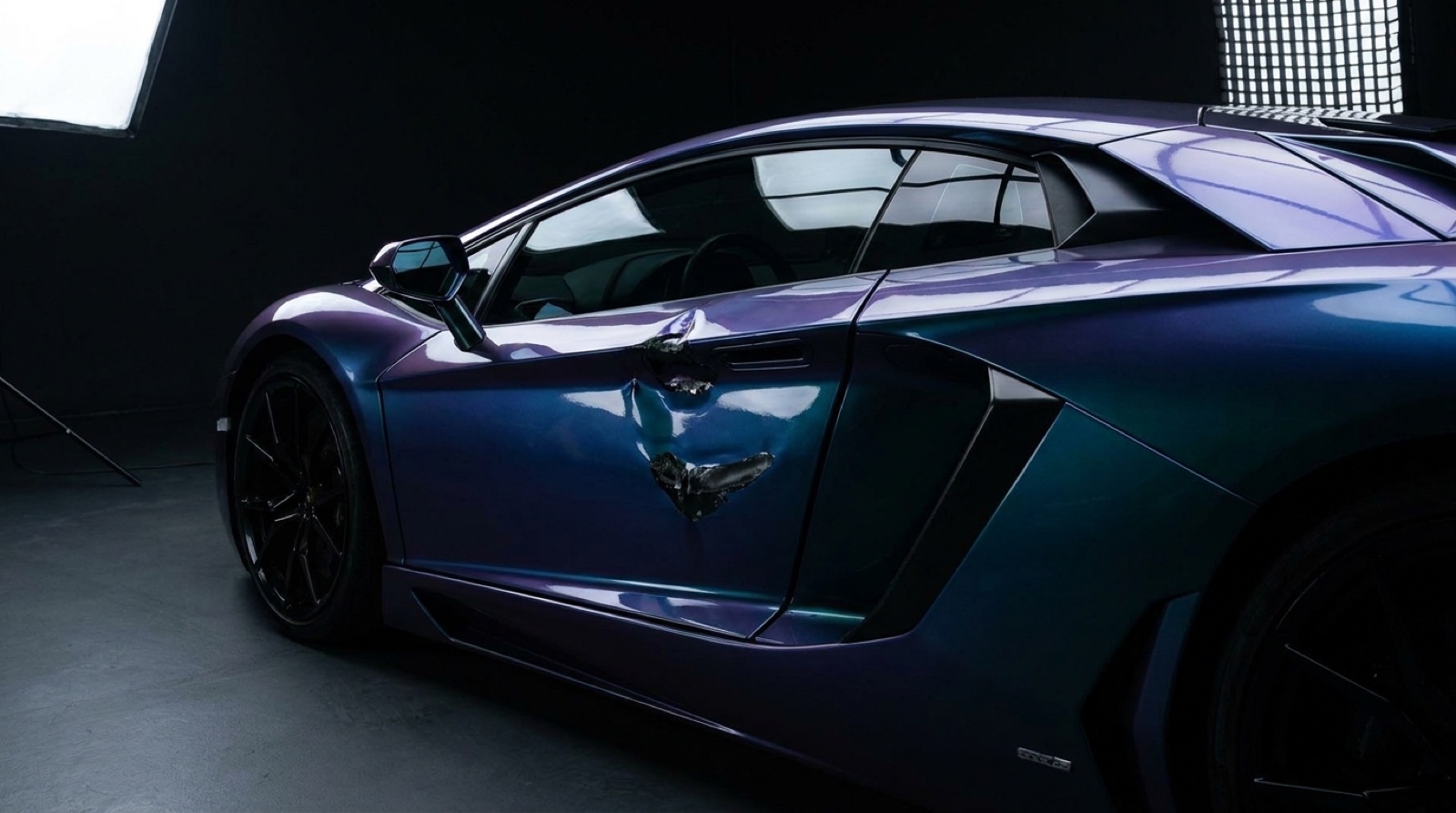
Yes, you can wrap a car with dents or bad paint. But vinyl does not hide damage, it follows it.
A dent under vinyl is still a dent, only now it has a glossy finish drawing your eye straight to it. Bad paint is a different problem, because it affects whether the wrap sticks at all.
The real question is not whether the wrap will go on. It is whether it will look right and stay on.
Vinyl is thin. Most wrap film runs somewhere between 3 and 4 mils thick, which is roughly the thickness of a sheet of paper.
It has no filling capability whatsoever. When it lays over a dent, it conforms to the shape of that dent and reveals it.
Gloss finishes make this worse because they reflect light. A shallow ding that you barely notice on faded factory paint becomes obvious under a gloss black wrap.
Matte and satin films are more forgiving. They scatter light instead of reflecting it, so minor surface irregularities read as less severe.
Textured films like carbon fiber and brushed metal hide the most. The texture itself breaks up the reflection.
None of these fix a dent. They just make a small one less of a spotlight.
| Damage | Wrap Over It? |
|---|---|
| Small door ding, no paint break | Usually fine, slightly visible |
| Dent larger than a golf ball | Fix first, it will show clearly |
| Creased or folded panel | Fix first, vinyl may lift at the crease |
| Sharp edge or torn metal | Must repair, film will tear |
| Deep dent with cracked paint | Must repair, adhesion will fail |
Paintless dent repair is the cheap path here. It costs far less than bodywork and gets a panel wrap ready in a day or two.
Wrap adhesive bonds to the clear coat. If the clear coat is failing, the adhesive bonds to something that is already letting go of the car.
Peel that wrap off in three years and you take the paint with it. That is not a hypothetical, it is the standard outcome.
New Orleans is rough on paint. Sustained UV exposure, humidity that rarely drops, and salt air off the lake and the Gulf all accelerate clear coat failure faster than most of the country.
Faded paint is one of the most common reasons drivers around Metairie and Gretna come in for a wrap in the first place. If the clear coat is intact, a full color change solves it for a fraction of a repaint.
Fresh paint needs time. Most manufacturers want 30 days minimum before wrapping, and many installers prefer 60 to 90.
Solvents keep escaping from cured paint for weeks. Trap them under vinyl and you get bubbles, discoloration, and adhesive that never fully sets.
Ask the body shop what they sprayed and when. If they used a low quality single stage paint, wrapping over it is a gamble regardless of cure time.
Any competent installer inspects the vehicle before quoting. Not photos, the actual car in person.
That inspection should tell you which panels are wrap ready, which need prep, and which need bodywork first. A shop that quotes a full wrap sight unseen on a car you described as having damage is not doing you a favor.
Sometimes the answer is to skip the damaged panel entirely. A partial wrap covering the hood, roof, and mirrors changes the look without touching a beat up rear quarter.
Adhesion promoter helps on marginal surfaces but it is not a rescue tool. It improves bond on edges and recesses, not on failing clear coat.
Proper prep means a full decontamination wash, a clay bar pass, and an isopropyl alcohol wipe on every panel. Any wax, sealant, or ceramic coating has to come off completely.
Commercial vehicles carry more damage than personal cars. That is the nature of the work.
Printed graphics on work trucks and vans hide minor imperfections better than solid colors do, since the design itself breaks up reflections. A busy layout across a cargo van door will disguise a ding that gloss white would announce.
For a mixed age fleet, the usual approach is to triage. Wrap the clean vehicles now, repair and wrap the damaged ones in a second round, and pull anything with structural rust out of the plan entirely.
A wrap is not a repair. It covers, it protects from new damage, and it changes color.
It does not restore panel geometry, stop rust, or fix a failing clear coat. If you want the underlying condition improved, that happens before the vinyl goes on, not because of it.
If your goal is protecting good paint rather than covering bad paint, clear protective film is the better product. It is built for impact resistance on surfaces that are already in good shape.
Bring the car in and let someone look at it. Ten minutes of inspection saves you from a wrap that bubbles at the crease or peels a panel when it comes off.
Our shop on Rousseau Street handles everything from custom vinyl work to straightforward color changes, and we will tell you directly if a panel needs attention first. Reach out for a quote and we will walk through what your vehicle actually needs.
Not Sure If Your Car Is Wrap Ready?
Bring it by our Rousseau Street shop for a straight answer on what needs prep and what does not.