
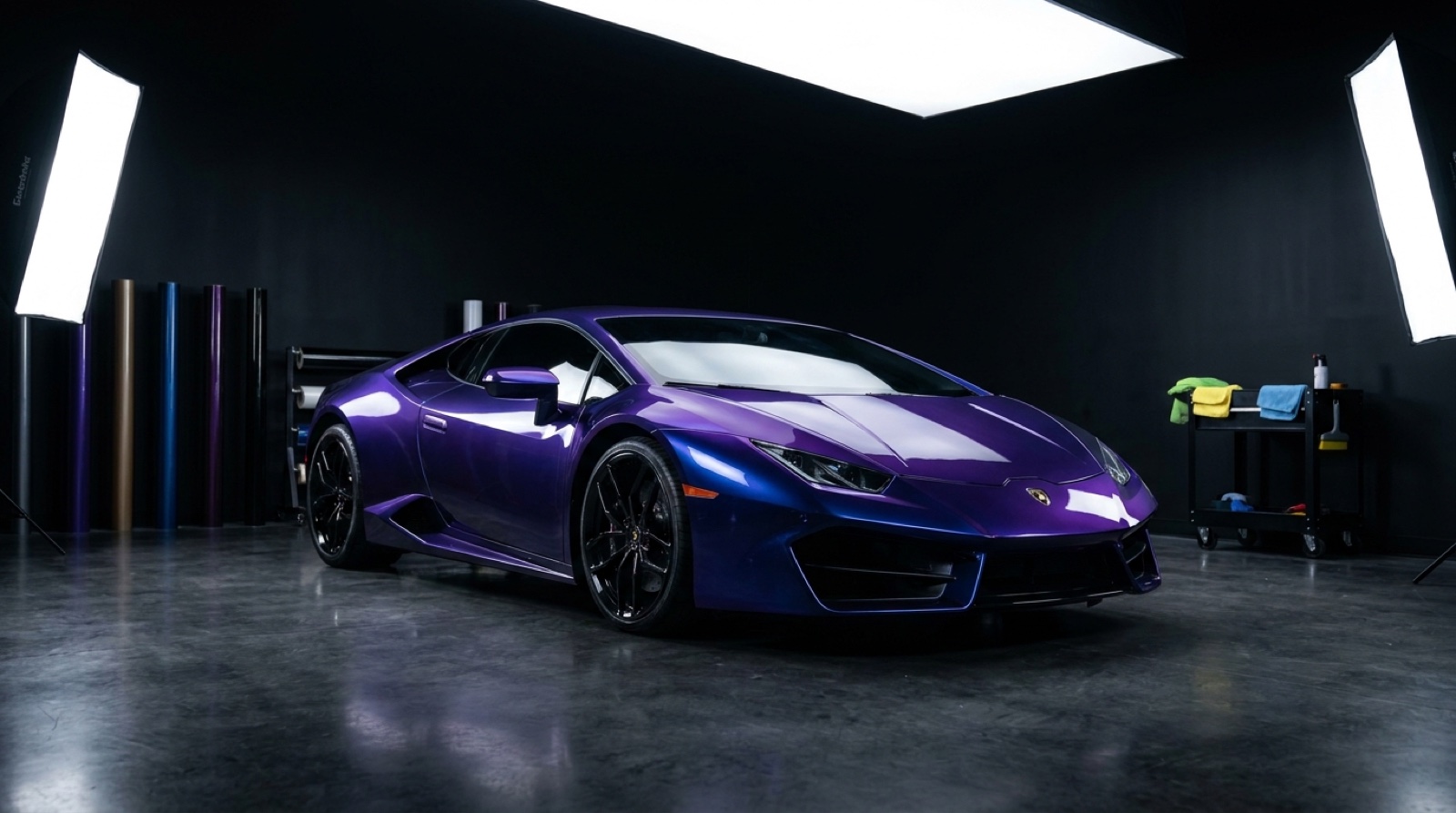
Yes, a new car is the best possible candidate for a wrap. Factory paint is smooth, uncontaminated, and free of the chips and oxidation that force prep work on older vehicles.
The vinyl lays down cleaner, the edges tuck tighter, and the finish looks closer to paint. You also lock in the paint underneath at the condition it will never be in again.
Vinyl is only as good as what it sticks to. On a car with three years of sun exposure, the clear coat has already started to break down at the microscopic level.
Adhesive still bonds, but it bonds to a compromised layer. On a car with 400 miles on the odometer, there is nothing between the adhesive and healthy clear coat.
That matters most at removal time. Wrap installed on sound paint peels off years later with no damage, while wrap installed over failing clear coat can lift flakes with it.
If the car has been repainted or had a panel resprayed at a body shop, wait. Fresh refinish paint continues to release solvents for roughly 30 to 60 days depending on the product and the booth.
Seal that off under vinyl too early and you trap gas under the film, which shows up as bubbles. Factory paint from the assembly line is fully cured and needs no waiting period at all.
Most factory palettes run four to six options, and half of them are grayscale. A full color change in vinyl opens up satin, matte, gloss, and shifting finishes that no dealer order sheet includes.
Reversibility is the part that sells people. Get tired of it in three years and the car goes back to the original paint underneath.
Sun and road grit are what kill paint value, and New Orleans supplies both in quantity. Summer UV on Loyola Avenue and salt spray coming off the Causeway both take their toll on a hood and front bumper.
A wrap takes that abuse instead of the clear coat. When it comes off before you sell or trade, the paint underneath is closer to showroom than a comparable car that spent five years uncovered.
A new van or truck is the natural moment for branding. Getting graphics on a service vehicle before it enters rotation means no downtime pulled out of a working schedule.
Businesses adding several vehicles at once usually run them through as a matched fleet package so the branding stays consistent across every unit.
These get confused constantly, and they do different jobs. Vinyl wrap changes appearance and shields against UV and light abrasion, while paint protection film is a thicker urethane built to absorb rock strikes.
| Feature | Color Change Wrap | Paint Protection Film |
|---|---|---|
| Changes color | Yes | No, it is clear |
| Rock chip defense | Light | Heavy |
| Typical lifespan | 5 to 7 years | 7 to 10 years |
| Common coverage | Full vehicle | Hood, bumper, mirrors, fenders |
| Relative cost | Lower per square foot | Higher per square foot |
Plenty of owners run both. Clear film on the impact zones handles the front end, and color vinyl covers the rest of the body.
It will not void your factory warranty. Vinyl is a removable surface layer and does not touch the powertrain or electronics.
It will not fix bad prep either. Even on new paint, the installer still has to strip the dealer sealant and any wax coating, because vinyl will not bond through a slick surface.
And it will not stop damage that reaches the metal. A deep gouge from a parking garage post goes through vinyl and paint alike.
A full wrap on a new car is a real expense, and there are cheaper ways to reach the same look. Not everyone needs every panel covered.
Worth noting for anyone still inside a finance or lease agreement: vinyl is fine because it comes off. Just plan the removal before the return date.
Louisiana humidity affects install conditions more than most climates. Vinyl needs a controlled indoor bay, since moisture on the panel surface interferes with adhesion and heat swings make the material behave unpredictably.
Anyone quoting a wrap done outdoors or in an open carport around here is setting you up for lifting edges by the following summer.
Heat also drives material choice. Dark matte finishes absorb noticeably more heat than gloss, which shortens their service life in a city that runs 90 degrees and humid from June through September.
If you want a different color, yes, and doing it now is better than doing it in four years. If your goal is purely protection, a quality ceramic coating or front end film may serve you better for less money.
If the vehicle earns its keep, branding it before the first job pays for itself faster than almost anything else you can add.
Bring the car by our shop on Rousseau Street or reach out for a quote and we will tell you honestly which option fits what you are actually trying to accomplish.
New Car? Wrap It Before the First Chip
Get a straight quote on color change, protection film, or branding for your new vehicle.